

Identify equipment for reuse
Once your organisation has made the decision to offer decommissioned devices for digital inclusion reuse it is useful to establish what you can contribute. This page shares guidance to support this stage. Note that IT Asset Disposition (ITAD) partners can help you with this step, you don’t need to do all this in-house.
Establish an inventory
- Work with IT and/or procurement colleagues to understand what devices are being decommissioned and when it will become redundant for the organisation.
- Your organisation may already have an IT asset register, which is essentially an itemised list of devices that the organisation holds. If you don’t have this it is useful to establish an inventory list of the devices that your organisation is decommissioning.
- An inventory list helps you determine how many devices you might have available through decommissioning and to keep track of them as they go through the process.
Identify device categories
- As you collate the inventory list it is useful to capture information about the devices that you have. This will help to determine the outcome for your devices. The three most likely outcomes for your devices are that they will be: refurbished for digital inclusion reuse, sold for reuse in the general market or recycled.
- The most useful information to provide those supporting with the outcome decision is an inventory that includes item type, make/model, volume. It can also be beneficial to share whether the devices are in working order and whether power cables will be supplied.
- Those supporting with the outcome decision may have an eligibility criterion that details what information they require and what product categories they will accept. Look out for this when selecting ITAD partners to work with.
Understand what has value
- The core device categories that are most likely to be reused for digital inclusion are smartphones, tablets and laptops. However, some organisations and individuals can also make use of mobile phones that aren’t smartphones, desk top computers and other types of devices such as AV equipment.
- Some devices, such as printers, monitors or servers may not be eligible for direct digital inclusion reuse but still have value that can be leveraged. For example, these devices could be resold and the income generated used to cover costs associated with the process or donated to digital inclusion causes. If your organisation needs to receive some income back as a rebate talk to your ITAD partner about possible outcomes and your needs as an organisation.
- Base decisions on what will be the best outcome for the devices you have, maximising assets for the biggest impact e.g., will it meet the needs of your beneficiaries better to refurbish one expensive old laptop, or to sell that laptop and buy multiple mobile phones? Such purchases can still be refurbished items – it is good procurement practice/policy to always buy refurbished first where possible.
Case study
The National Device Bank
Good Things Foundation partnered with Reconome to get almost 18,000 devices to those who need them the most.

Case study
The National Device Bank
In 2022 Good Things Foundation went into partnership with B Corp certified Reconome  to offer a cost neutral solution for organisations seeking to reuse their tech for social good. To date the partnership has collaborated with 75 organisations and processed 64,688 assets on behalf of those organisations, preventing 114,429Kg of e-waste and providing 17,631 digitally excluded people with a refurbished device.
In 2022 Good Things Foundation went into partnership with B Corp certified Reconome to offer a cost neutral solution for organisations seeking to reuse their tech for social good. To date the partnership has collaborated with 75 organisations and processed 64,688 assets on behalf of those organisations, preventing 114,429Kg of e-waste and providing 17,631 digitally excluded people with a refurbished device. Along the way there has been a lot of learning around what does and doesn’t have value! Around 30% of what has been collected has needed to be recycled (which does come at a cost) however 70% had sufficient value to cover the operational costs of the Device Bank and generate 17,631 devices for donation to digitally excluded individuals. We have core categories of reusable tech like smartphones, tablets and laptops that we prefer to receive, but then secondary categories of tech like desktops, printers, av equipment, monitors and even servers are always considered. Sometimes this can generate income which is then reinvested into refurbishing and distributing the reusable tech – it’s all supporting digital inclusion.

How to tell if your devices are suitable for reuse or recycling
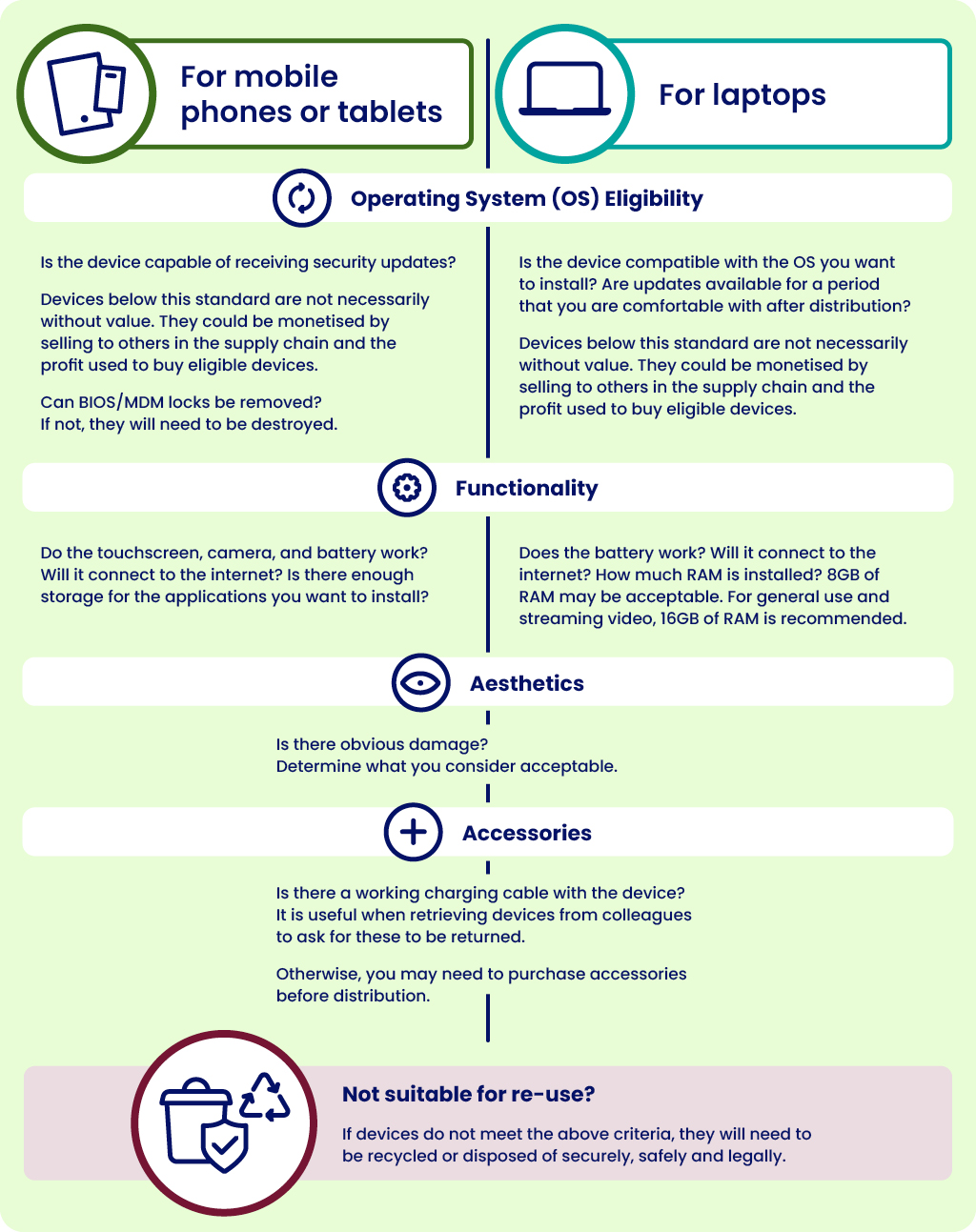
| Device type | Assessment area | Questions and guidance |
|---|---|---|
| Mobile phones or tablets | Operating System (OS) Eligibility |
Is the device capable of receiving security updates? Devices below this standard are not necessarily without value. They could be monetised by selling to others in the supply chain and the profit used to buy eligible devices. Can BIOS/MDM locks be removed? If not, they will need to be destroyed. |
| Laptops | Operating System (OS) Eligibility |
Is the device compatible with the OS you want to install? Are updates available for a period that you are comfortable with after distribution? Devices below this standard are not necessarily without value. They could be monetised by selling to others in the supply chain and the profit used to buy eligible devices. |
| Mobile phones or tablets | Functionality |
Do the touchscreen, camera, and battery work? Will it connect to the internet? Is there enough storage for the applications you want to install? |
| Laptops | Functionality |
Does the battery work? Will it connect to the internet? How much RAM is installed? 8GB of RAM may be acceptable. For general use and streaming video, 16GB of RAM is recommended. |
| All devices | Aesthetics |
Is there obvious damage? Determine what you consider acceptable. |
| All devices | Accessories |
Is there a working charging cable with the device? It is useful when retrieving devices from colleagues to ask for these to be returned. Otherwise, you may need to purchase accessories before distribution. |
| All devices | Not suitable for re-use? |
If devices do not meet the above criteria, they will need to be recycled or disposed of securely, safely and legally. |
Case study
Refurbishing devices, for those in need: DVLA
DVLA’s Digital Inclusion Scheme supports schools and charities.

Case study
DVLA
DVLA’s Digital Inclusion scheme, launched in September 2021, donates IT equipment that is no longer needed by the organisation to schools and charitable organisations across Wales. The aim of the scheme is to improve access to IT for all children and underrepresented groups.
Reusing DVLA’s IT equipment offers children and young adults in Wales increased opportunity to access the IT equipment they need to develop their digital skills and supports the circular economy in Wales.
DVLA has a contract in place with E-Cycle, an IT asset management company based in Tonypandy, to refurbish and recycle our unused IT equipment. This equipment includes all types of electronic waste (e-waste) such as laptops and desktops that are no longer in use. E-Cycle ensure our IT equipment is dealt with in the most sustainable way possible, either through refurbishing for reuse or recycling.
DVLA wipes all data from any devices and sends batches of equipment to E-Cycle, often containing 100s of laptops at a time. All devices which can be refurbished are cleansed to agreed government standards and provided with operating system licences via the Microsoft Authorised Refurbisher programme before being distributed through our agreed and approved partners.

What if your devices are not suitable for reuse?
- The best thing to do is find a reputable partner who can dispose of Waste Electrical and Electronic Equipment (WEEE). They should be an accredited Approved Authorised Treatment Facility (AATF) for WEEE. An IT Asset Disposition (ITAD) would probably either already be an AATF, or have links to one.
- You could also find your nearest donation or recycling point at Recycle Your Electricals from recycling centres to shops, charities to community drop-off points, there’s almost 30,000 locations on their locator to donate or recycle your old electricals.
Employee Tech Amnesties and Community Donations
Your organisation might consider facilitating an employee tech amnesty whereby colleagues can bring their old devices into work for donation or you might consider pooling donations across small organisations or setting up community drop off points.
This approach can carry challenges if your primary focus is to increase the number of devices reused for social good. For example, there are increased risks around data protection in handling employees’ personal devices. Pilots by organisations like Good Things Foundation and Material Focus suggest that the potential for reusable devices is very low, and this approach can lead to incurred costs for your charity or refurb partners.
Help your employees, customers and community better understand how to manage their tech – and explain what you’re doing in your organisation. You could speak to Material Focus, who run the Recycle Your Electricals campaign, or download their toolkits to make it easy. They have ready made templates, a Recycling Locator, and guidance to help you do this. Or The Restart Project helps people rethink how they consume electricals and maybe even learning how to give it a second lease of life for themselves.
You could partner with Hubbub which runs a successful scheme, Community Calling, focused on smartphones.