

Distribution
Who will receive your devices and how is a critical question to answer in setting up an IT Re-use for Good scheme.
- You could work collaboratively with your IT Asset Disposition (ITAD) partner, who may have routes for charitable donations.
- You could partner with a National distribution scheme like those delivered by Good Things Foundation and Digital Poverty Alliance who will handle everything on your behalf.
- Alternatively you could identify regional or local, community based organisations that you could partner with to process and distribute devices, keeping it hyper local.
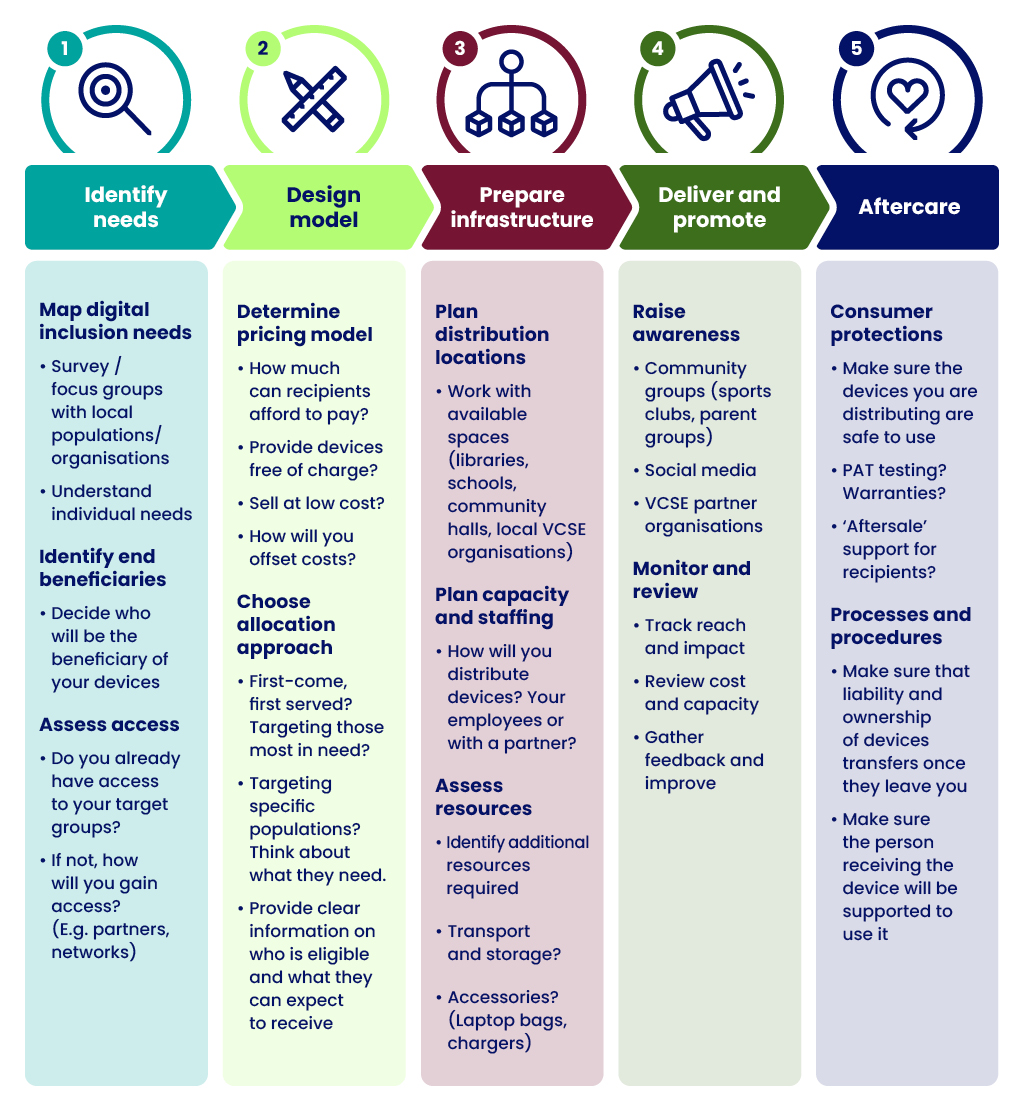
The diagram below shows the different considerations when distributing devices, depending on the resource you have available these steps could be undertaken in house or with a partner organisation.
1. Identify needs
Map digital inclusion needs
- Survey / focus groups with local populations/organisations
- Understand individual needs
Identify end beneficiaries
- Decide who will be the beneficiary of your devices
Assess access
- Do you already have access to your target groups?
- If not, how will you gain access? (E.g. partners, networks)
2. Design model
Determine pricing model
- How much can recipients afford to pay?
- Provide devices free of charge?
- Sell at low cost?
- How will you offset costs?
Choose allocation approach
- First-come, first served? Targeting those most in need?
- Targeting specific populations? Think about what they need.
- Provide clear information on who is eligible and what they can expect to receive
3. Prepare infrastructure
Plan distribution locations
- Work with available spaces (libraries, schools, community halls, local VCSE organisations)
Plan capacity and staffing
- How will you distribute devices? Your employees or with a partner?
Assess resources
- Identify additional resources required
- Transport and storage?
- Accessories? (Laptop bags, chargers)
4. Deliver and promote
Raise awareness
- Community groups (sports clubs, parent groups)
- Social media
- VCSE partner organisations
Monitor and review
- Track reach and impact
- Review cost and capacity
- Gather feedback and improve
5. Aftercare
Consumer protections
- Make sure the devices you are distributing are safe to use
- PAT testing?
- Warranties?
- ‘Aftersale’ support for recipients?
Processes and procedures
- Make sure that liability and ownership of devices transfers once they leave you
- Make sure the person receiving the device will be supported to use it
Case study
#CovConnects (Coventry City Council)
Positive social impact drives #CovConnects.

Case study
#CovConnects (Coventry City Council)
Positive social impact is such an important driver for #CovConnects – and we understand that digital inclusion enables diverse positive outcomes for different people and communities.
The #CovConnects Device Bank isn’t just about providing the ‘tech’, it’s about supporting the people involved too. Our wider holistic person-centred approach ensures that our partners feel confident and able to increase the skills and confidence of their residents & communities. We run a training programme for our partners, in collaboration with Digital Unite, called Digital Champions as well.
Our people centric approach has included the creation of bespoke digital inclusion networks and unique training offers. Ranging from workshops for community partners around health to interactive sessions for young people around digital literacy these workshops cover the breadth of issues found in the city.

Case study
Deloitte’s Device Distribution Pathway
Connecting donated devices with those experiencing digital exclusion.

Case study
Deloitte
Deloitte’s device donation programme uses effective distribution pathways to connect donated devices with those experiencing digital exclusion. The programme’s success is driven by strategic partnerships, and a robust process. The structured approach ensures efficient resource allocation and maximises the programme’s positive social impact.
Decision tree and asset management:
Deloitte refreshes its devices every three years. Once a device is collected by their ITAD partner and assessed, a decision tree determines its next destination: redeployment within Deloitte or donation. Donated devices are added to Deloitte’s
dedicated ‘charity’ stock.
Beneficiary Selection:
Deloitte prioritises beneficiaries aligned with its strategic focus areas, using a multi-faceted approach:

- Schools and education: this key focus includes schools near Deloitte offices, nominations from Deloitte’s Governors network and employees, educational providers collaborating with Deloitte’s Early Careers team (school leaver recruitment), and young people attending Deloitte career insight days.
- Charities: Deloitte supports charities near its offices, has established partner charities, and welcomes employee nominations, extending the programme’s reach.
- Social Value delivery partners: Devices are provided to organisations enhancing digital skills training within Deloitte’s social value commitments for Government and Public Sector clients.
- Scale device donation distribution charities: partnerships with organisations like Good Things Foundation leverage their expertise to reach underserved communities more effectively.
Distribution process with ITAD:
A streamlined, technology-driven process manages distribution
- Centralised communication & tracking: a shared online platform and master tracker provide real-time visibility into each device’s journey, fostering transparency and efficient collaboration.
- Inventory management: weekly updates from ITAD on available devices allow Deloitte to manage requests effectively.
- Application & review: bi-weekly reviews of online applications ensure alignment with programme criteria. Approved requests are logged in the shared tracker.
- ITAD action & delivery: ITAD is directly notified, contacting recipients to schedule delivery, minimising delays.
- Real-time updates: the master tracker’s constant updates enable swift responses to queries and maintain transparency.
- Data privacy: the shared platform minimises email communication, reducing the risk of data breaches and enhancing privacy.
Case study
Supporting schools and charities: DVLA
Improving access to IT for all children and underrepresented groups.

Case study
DVLA
“DVLA’s Digital Inclusion scheme, launched in September 2021, donates IT equipment that is no longer needed by the organisation to schools and charitable organisations across Wales. The aim of the scheme is to improve access to IT for all children and underrepresented groups. Reusing DVLA’s IT equipment offers children and young adults in Wales increased opportunity to access the IT equipment they need to develop their digital skills and supports the circular economy in Wales.
“We are proud to be able to support the community in this way. The launch of the Digital Inclusion scheme also supports our ambition of contributing to a strong digital economy. In the last two years, we have donated more than 1,000 laptops. As well as schools in the region we have also donated laptops to charitable organisations who share our ambition to make digital more accessible to children and young adults. In the last year we have donated to Race Council Cymru, Matthew’s House and Interplay Swansea who have been able to pass on the devices to their communities.“